
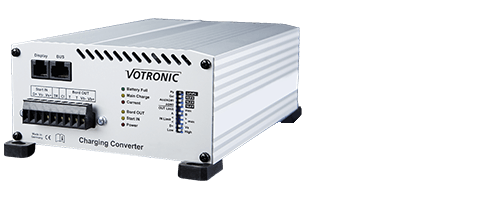
Battery-to-battery charger VCC 1212-70 CI - optimum charging even on short journeys
12V to 12V | 70A charging booster | EURO 6 | Lead-acid, gel, AGM and lithium batteries | IU1oU2 charging curve | 9 charging programmes
The new VCC 1212-70 CI is the successor to the proven VCC 1212-70 and introduces a key advancement: the integration of the CI-BUS interface.
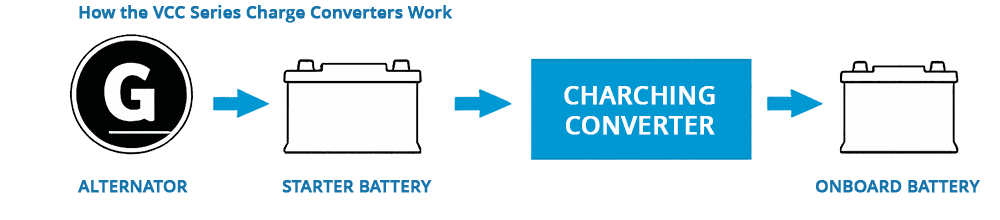
As a fully automatic battery-to-battery charging converter (booster), the VCC 1212-70 CI has been specially developed for mobile use in motorhomes, boats and special-purpose vehicles. While driving, it reliably charges the leisure battery from the alternator via the starter battery.
Unlike a conventional isolation relay, the battery-to-battery charger specifically adjusts the charging voltage according to the selected charging programme – both upwards and downwards. This makes it particularly suitable for EURO 6 and 6+ vehicles, where the alternator voltage can fluctuate significantly.
Nine selectable charging programmes cover a wide range of battery technologies – from conventional lead-acid, gel and AGM batteries to modern lithium LiFePO4 batteries. They ensure fully automatic, rapid and gentle full charging from any state of charge, followed by automatic full charge maintenance and battery conditioning.
Even on short journeys, the battery is supplied with the full charging current. Connected 12V consumers are automatically supplied at the same time – even when the vehicle electrical system is heavily loaded. The integrated automatic power control ensures the necessary level of safety at all times while maintaining the vehicle's ability to start.
General design recommendation: To avoid overloading the alternator, its rated output should ideally be approximately twice the rated current of the charging booster. For a 50A charging booster, an alternator rated at at least 100A is therefore recommended.
Features:
- 12V to 12V / 70A
- integrated CI-BUS
- for lead-acid, gel, AGM and LiFePO4 batteries
- compensates for cable losses and alternator voltage fluctuations
- for vehicles meeting EURO 6 and 6+ standards
- 9 selectable charging programmes
- protects connected 12V consumers against overvoltage and voltage fluctuations
- high charging performance even on short journeys
- full charging during longer journeys
- no intervention in the starter circuit
- fully automatic charging – integrated protection functions
- connection for battery temperature sensor (included)
- compact design, low weight
What advantages does the CI-BUS offer with the VCC 1212-70 CI?
In an increasing number of caravans and motorhomes, modern CI-BUS onboard management systems provide centralised control of a wide range of devices and functions within the onboard network – reflecting the continuing digitalisation of the leisure vehicle sector. Innovative solutions such as wireless control of heating, air conditioning and other onboard equipment via laptop, tablet or smartphone are becoming increasingly common when travelling, providing both greater convenience and improved energy efficiency.
Thanks to the integrated CI-BUS, the VCC 1212-70 CI integrates seamlessly into modern onboard management systems, making it ideally equipped for today's and tomorrow's connected onboard technology. Connection to a CI-BUS onboard management system for displaying all relevant data on a central vehicle display is made via the 9-pin plug-in terminal block and must be integrated into the CI-BUS onboard management system!
The CI-BUS was established in 2011 under the leadership of the Caravaning Industrie Verband (CIVD) as a common industry standard for the caravan sector. It represents forward-looking technology and flexible solutions, has been continuously developed ever since and provides the basis for the connected and convenient onboard electrical systems of the next generation.
Which charging modes does the VCC 1212-70 CI offer?
The unit features 9 charging programmes for different battery types, which can be conveniently selected using the four slide switches. Unless the battery manufacturer specifies otherwise, the appropriate charging programme can be easily determined using the operating instructions and the technical specifications – particularly the U1 and U2 voltages. All charging programmes automatically take into account possible parallel and buffer operation with connected 12V consumers on the leisure battery.
Please always observe the battery manufacturer's charging instructions!
Lead batteries (wet, gel, AGM):
Four specially adapted charging characteristics with corresponding charging voltages and integrated temperature compensation ensure optimum and gentle charging of lead-based batteries.
- Lead Acid: Universal charging characteristic for wet lead-acid batteries in accordance with DIN 57 510 / VDE 0510 for charging and maintaining leisure batteries. U1=14.40V / 2…6h | U2=13.50V / 24h | U3=13.20V / continuous
- Gel: Designed for sealed, gas-tight gel/dryfit VRLA batteries with fixed electrolyte, which generally require longer U1 holding times. U1=14.40V / 6…12h | U2=13.80V / 48h | U3=13.50V / continuous
- AGM 1 14.4V: Designed for sealed, gas-tight AGM (Absorbent Glass Mat) / lead-fleece VRLA batteries with a specified charging voltage of “14.4V”. U1=14.40V / 1.5…5h | U2=13.50V / 24h | U3=13.20V / continuous
- AGM 2 14.7V: Designed for sealed, gas-tight AGM (Absorbent Glass Mat) / lead-fleece batteries, Lead Crystal and VRLA batteries with a specified charging voltage of “14.7V or 14.8V”, as well as “Lead Crystal” batteries (14.7V). U1=14.7V / 1.5–5h | U2=13.6V / 24h | U3=13.20V / continuous
LiFePO4 batteries:
Five specially adapted charging characteristics with corresponding charging voltages and temperature monitoring ensure optimum and safe charging of modern lithium batteries.
- LiFePO4 13.2V: Designed for overwintering or storage of a LiFePO4 battery. 13.20V continuous
- LiFePO4 14.4V heated: U1=14.4V / 0.3–1h | U2=13.8V / continuous
- LiFePO4 14.2V: U1=14.20V / 0.5h | U2=13.60V / 24h | U3=13.40V / continuous
- LiFePO4 14.4V: U1=14.40V / 0.3…1h | U2=13.80V / continuous
- LiFePO4 14.2V heated: U1=14.20V / 0.3…0.5h | U2=13.60V / 24h | U3=13.40V / continuous
Attention: Never charge lithium-ion batteries when their temperature is below 0°C. If the battery has an integrated heater, charging is of course possible once the heater, powered by the charging current, has warmed the battery to above 0°C.
Additional settings and functions of the VCC 1212-70 CI (6 slide switches)
OUT Limit – max. (reduce charging current to the leisure battery):
The maximum charging current of the VCC 1212-70 CI can be limited using a switch. This allows the charging booster to be adapted to smaller leisure batteries or reduces the load on an existing electroblock, such as an EBL.
With the switch set to “max”, the full charging current range of 0A to 70A is available. When the “OUT Limit” current limitation is activated, the maximum charging current is reduced to 50A.
off – Rev. Charge (auxiliary charging branch only available with D+ control):
When the leisure battery is being charged by an external source, such as a mains charger, the integrated auxiliary charging output enables automatic support charging and charge maintenance of the vehicle starter battery. A portion of the available charging current is regulated, monitored and supplied to the starter battery. The auxiliary charging output provides a charging current of up to 5A.
This function is particularly useful during extended periods of inactivity or when the starter battery is subject to continuous power consumption, for example from vehicle electronics, lighting or audio equipment. The regulated charging function prevents the starter battery from being overcharged.
When the leisure battery has a sufficient state of charge, the starter battery is automatically charged with a charging current of up to 5A. The auxiliary charging branch should remain deactivated if the starter battery is already supplied by a mains charger, solar charge controller or EBL electroblock with a separate charging output.
IN Limit – max (limit current draw from the starter circuit/alternator):
The two switches can be used to limit the maximum current draw of the charging converter from the starter battery. This is useful if the alternator, connectors, cables, fuses or other components in the supply circuit have limited current-carrying capacity.
The current limitation has the greatest effect under high load, when the charging converter is providing a high charging current and charging voltage while the input voltage on the starter battery side is low. This operating condition can occur particularly as the leisure battery approaches full charge.
Setting the operating mode of the charging converter at the starter battery (IN, input side):
The automatic control (activation) of the charging converter after the engine is started can be achieved in two ways:
- For special applications, voltage-controlled via the increased starter battery voltage while the engine is running (not suitable for EURO 6 vehicles!)
- Recommended: via the vehicle's D+ signal (alternator active) or via vehicle terminal 15 when the ignition is switched on.
Option: Parallel connection of two charging converters:
To increase charging capacity for large battery banks or high loads (e.g. operation of an air conditioning system with the lower-output units), two identical units can also be connected in parallel. To ensure equal power distribution, both units should be connected as symmetrically as possible using identical cable lengths and cable cross-sections. The charging boosters should also not load the alternator by more than 50–60%.
Option: Multiple batteries at the charging output:
Parallel charging of two or more batteries with the same voltage (12V) is permitted. For this purpose, the batteries are connected “in parallel” and their capacities (Ah) are added together. The total capacity (sum of Ah) should not exceed the specified maximum battery capacity for the respective application.
Optional accessories for the VCC 1212-70 CI
LED Remote Control S | 2076 for current VCC 1212 series charging converters or LCD Charge Control S | 1248 compatible with Votronic VCC series charging converters
Even when the unit is installed in a difficult-to-access location, you can conveniently keep an eye on it at all times. The control and operating unit enables convenient remote monitoring and operation, while the LEDs provide a clear indication of the current device status and charging progress. Thanks to the plug-and-play connection, the control unit is easy to install. The integrated switch also enables control of device-specific functions.
Back Contact Relay 60A / 12V | 2202 (for EBL)
When used in combination with an electroblock (e.g. Schaudt), installation of this changeover relay is mandatory. It prevents charging current from flowing back from the VCC via the leisure battery into the starter battery. As soon as the engine is running and a D+ signal is present, it disconnects the connection between the starter battery and the electroblock. When the D+ signal disappears after the engine is switched off, the connection is automatically restored.
Votronic High-Power Cut-Off Relay 12V / 140–200A | 2203 | Bypass Relay
Bypass relay that can additionally be used where a very high-power consumer may draw more current from the leisure battery than the charging booster can provide, for example when operating a habitation air conditioning system while driving via a powerful inverter. A dedicated switching output on the VCC activates the bypass relay if current consumption becomes too high, thereby bypassing the integrated charging booster. When the load current decreases, the relay is switched off and the charging converter resumes controlled full charging of the leisure battery.
Comparison of VCC battery-to-battery chargers
Note: Further technical data for the devices listed in this comparison can be found on the respective product detail page under the “Technical Data” tab or in the respective operating manual under the “Download” tab.
Scope of delivery:
- 1x Votronic battery-to-battery charger VCC 1212-70 CI | 3362 | charging booster
- 1x Temperature sensor | 825
- 1x Installation and operating manual
- Of course, a German operating manual is also available from our download section.
You can find further helpful tips on our FAQ page with questions and answers via the following link FAQ.


